Creating and Editing a Widget Formula
Last updated: June 23, 2026
| Tier | Deployment |
|
|
|
The Data Browser enables you to use formulas (freeform expressions) to determine the values and filters of a widget. A rich variety of functions is provided for your use in formulas, empowering you to achieve:
-
Speed to Insight: Analyses which previously required nightly builds can be done here in seconds.
-
Self-Service Autonomy: Analysts are able to answer follow-up questions during meetings rather than taking "action items for the data modelers."
-
Cleaner Governance: Keeps the core data model clean and performance-optimized, while allowing endless flexibility at the analytics layer.
To create or edit a formula:
- Open the formula editor in the Data Browser:
- For a new widget, click Select Data, and then
 .
. - For an existing widget, click the edit formula button
 .
.The Data Browser then changes to display the Formula Editor, which has the following tabs:
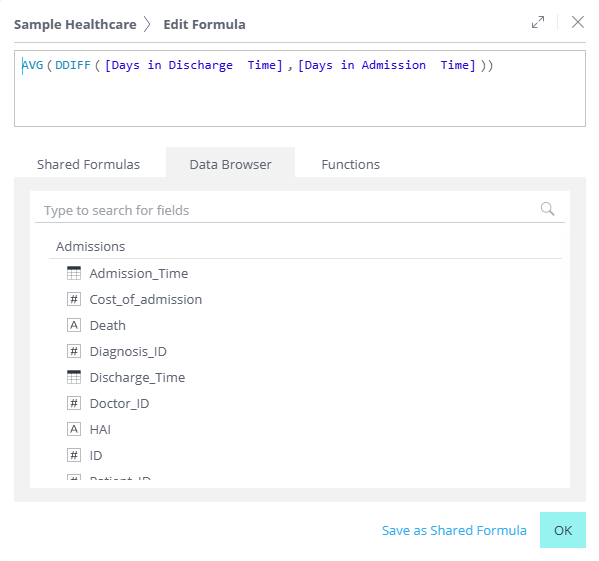
- Shared Formulas: Displays the existing shared formulas that can be used. See Shared Formulas.
- Data Browser: Provides selectable fields from the data model.
- Functions: Lists the functions that can be selected for your formula. Hovering over a function in the list displays a tooltip that describes that function.
- For a new widget, click Select Data, and then
- Compose the formula as follows:
- From the Shared Formulas tab, select the relevant shared formula to use, on its own or as part of a larger formula being created.
- From the Data Browser tab, select one or more fields.
- From the Functions tab:
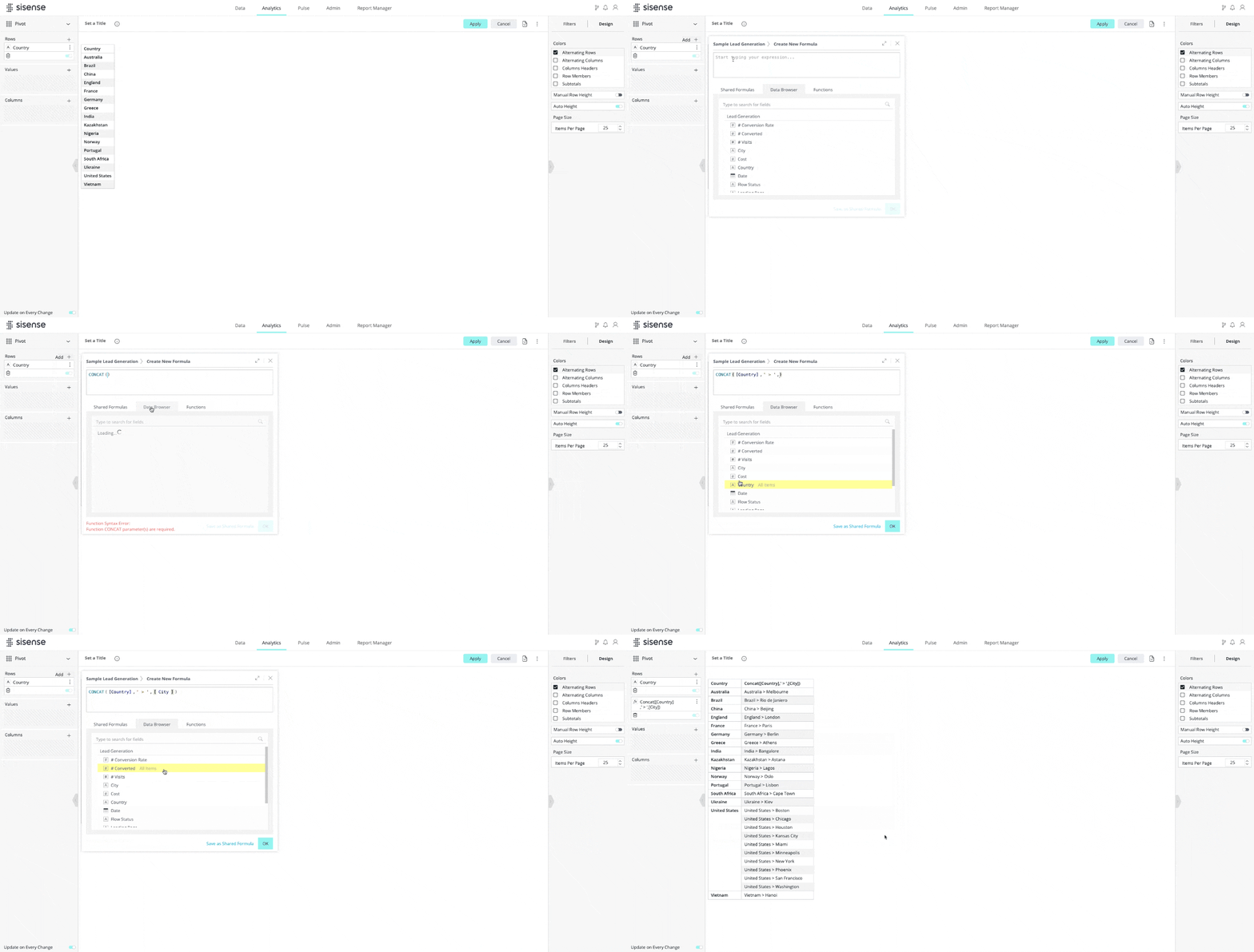
- For string functions (calculated dimensions) select the required functions as shown:
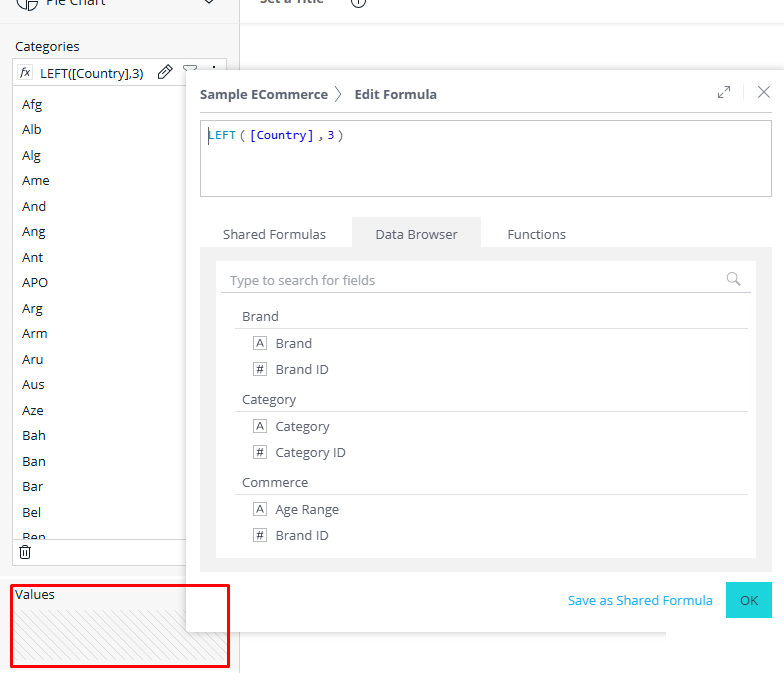
- For non-string functions, click Values in the sidebar and add the formula as shown:
- For string functions (calculated dimensions) select the required functions as shown:
- Type in the required parts of the formula. To see examples, see Creating Formulas Based on Criteria and Conditions (Filters), and Dashboard Functions Reference.
- Click OK.
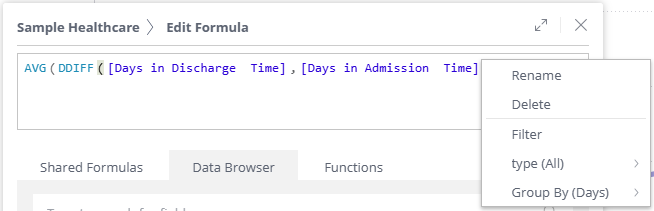
If you hover over a formula and right-click, you have the following options:
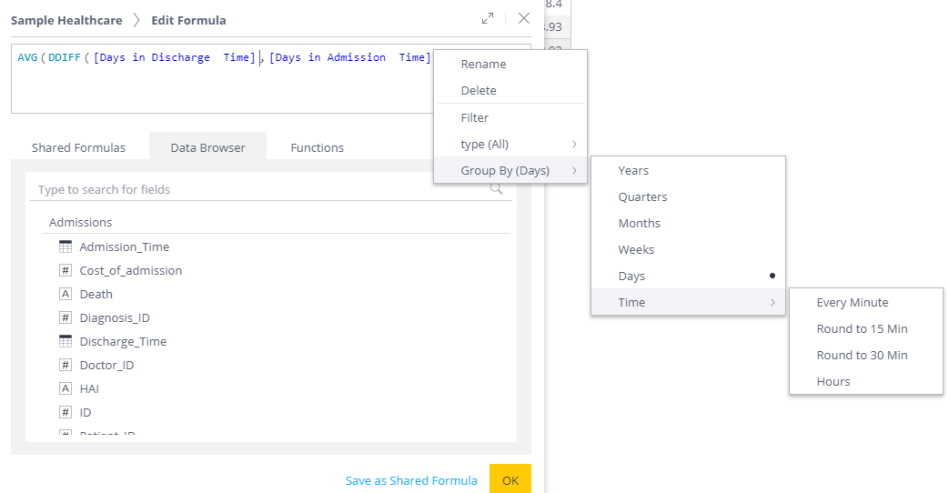
- Rename - Renames the formula. For example, give it a name that represents a real-life task or expected result from the formula, or include in the name filters that you have added to the formula.
- Delete - Deletes the formula item.
- Filter - Adds filters to the formula.
- Type - Changes the default aggregation method, for example, from Sum to Average.
- Group By (Days) - Determines the time buckets into which to group the values.
The right-click options for a filtered formula are:
Expected Behavior and Limitations
-
Formulas in “Categories“ type of panels are not supported and will be ignored by the system if they are added manually in the dashboard file. This does not include Calculated Dimensions, which are supported.
-
The list of functions available for use may vary when used inside a measure type of axis, or a dimension one. The same applies to the returned value expected - for measures it will be a number, while for dimensions it must result in a string value.
-
Calculated Dimensions were added in version 2026.1.1 as beta. They included string manipulation functions - “Left”, “Right”, and “Concat”. Starting version 2026.2.1 Calculated Dimensions are General Availability (GA), and include string comparison functions as well - “Case When”, and “If”. Calculated Dimensions allow the creation of formulas within the dimension axis, with some current limitations:
-
“Concat”, “Left”, “Right”, “Case When”, and “If” are the only functions currently supported, with future plans for further expansion.
-
Calculated dimensions only work when executed over the Analytical Engine.
-
For “Case When” and “If": One formula cannot support a mixture of multiple return data types.
-
For the Date field, String filters are the only filter types currently available.
-
The Left and Right functions only support positive integers. Providing negative values may result in unexpected behavior.
-
String constants are limited to a maximum of 50 characters.
-
The Concat function is limited to a maximum of 10 parameters.
-
Calculated dimension formulas must reference at least one column from the model. For example: CONCAT(‘abc’, ‘def’) or LEFT(‘abc’, 2) are not supported.
-
In order to use single or double quotes in a string constant, you must wrap the text with the other quotes (single for double; double for single). For example: “haven’t” or ‘Dwayne "The Rock" Johnson’.
-
Widget filters for Live providers are supported only when the calculated dimension fields are using the same source table.
-
For ElastiCubes only: When using the Left and Right functions on columns of type FLOAT, REAL, and DECIMAL containing numbers longer than 13 digits, the results may be rounded. In such cases (when handling long numbers), it is recommended to use the functions on TEXT, INT, and BIGINT columns.
-
-
In some cases, widgets may fail to load if the formula includes more than 15 values.
-
In some cases, widgets on Live models connected to MS SQL/Azure SQL can fail when long column names are used inside formulas that include the XDIFF function.