Semantic Enrichment
Last updated: October 1, 2026
| Tier | Deployment |
|
|
|
Semantic Enrichment enables you to use Sisense Intelligence to automatically provide descriptions for your data models’ tables and columns. This assists data administrators in creating clear and informative text that can be utilized by both humans and the Sisense Intelligence assistant, and NLQ. The primary purpose of the enrichment is to enable the assistant to better understand the models and to improve the answers provided. The descriptions will cover key aspects of the data, such as its nature, its usage, optional formatting for textual IDs, and a summary of the data's time granularity and attributes.
How Semantic Enrichment Relates to AI Context
Semantic Enrichment and AI Context are complementary, not alternatives.
Semantic Enrichment automatically generates descriptions, the factual layer that documents what each table and column is. Run it to give your model a strong baseline the AI can rely on.
AI Context is guidance you add manually to tell the AI how to interpret or use an object, the things a description cannot capture, such as business meaning, preferred terminology, or caveats.
For example, on the Revenue (Net) column, Semantic Enrichment might generate the description "Net revenue per order line, after refunds and discounts, in USD," while you add the AI Context "Use for revenue questions unless the user says 'gross'."
Start with Semantic Enrichment to get accurate descriptions across the model, then add AI Context only where you need to steer the AI beyond what the descriptions say. Generated descriptions require another build or publish before the assistant can use them. For more information, see AI Context (Beta).
Note:
AI Context does not replace descriptions, and it is not generated by Semantic Enrichment. It is authored by you.
Enabling Semantic Enrichment
This feature is currently off by default. In order to use Semantic Enrichment, it must be enabled by an Admin.
-
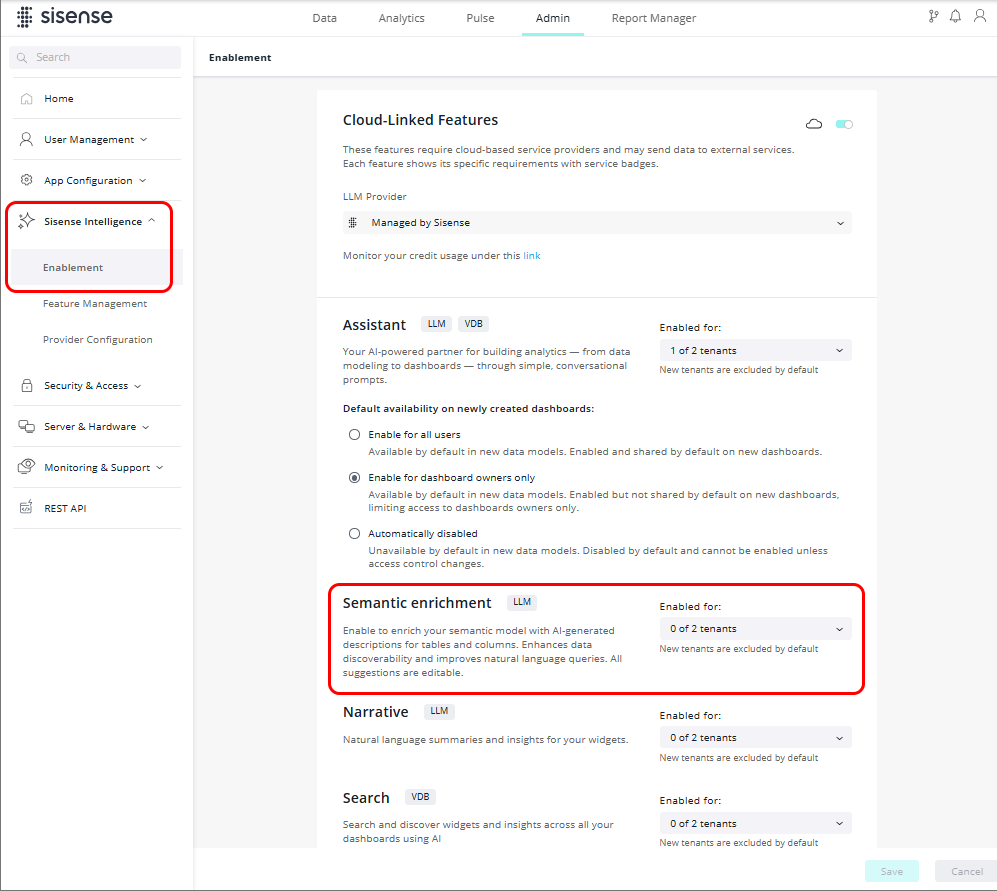
Enable Semantic enrichment at the tenant level in the Admin tab, under Sisense Intelligence > Enablement.
-
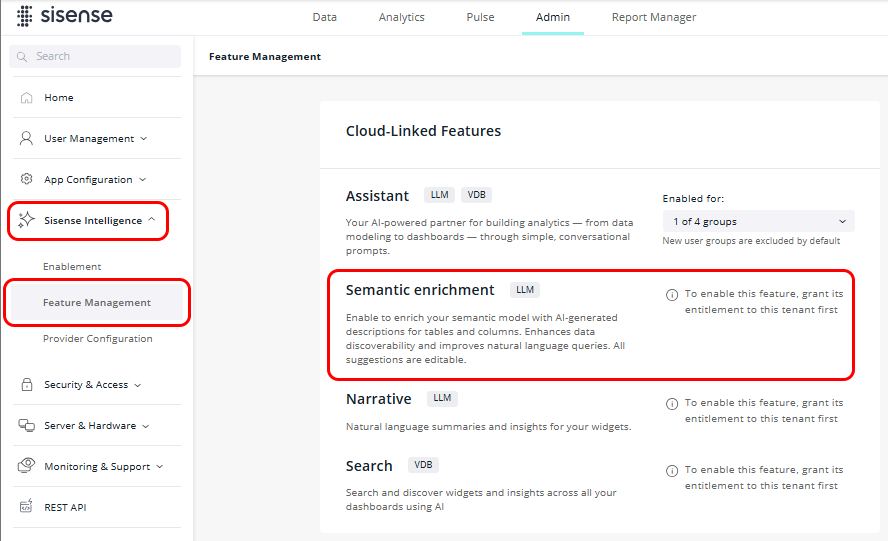
Enable Semantic enrichment at the user groups level in the Admin tab, under Sisense Intelligence > Feature Management.
Using Semantic Enrichment
-
In the Data tab, in the relevant data model, click
 > Semantic Enrichment.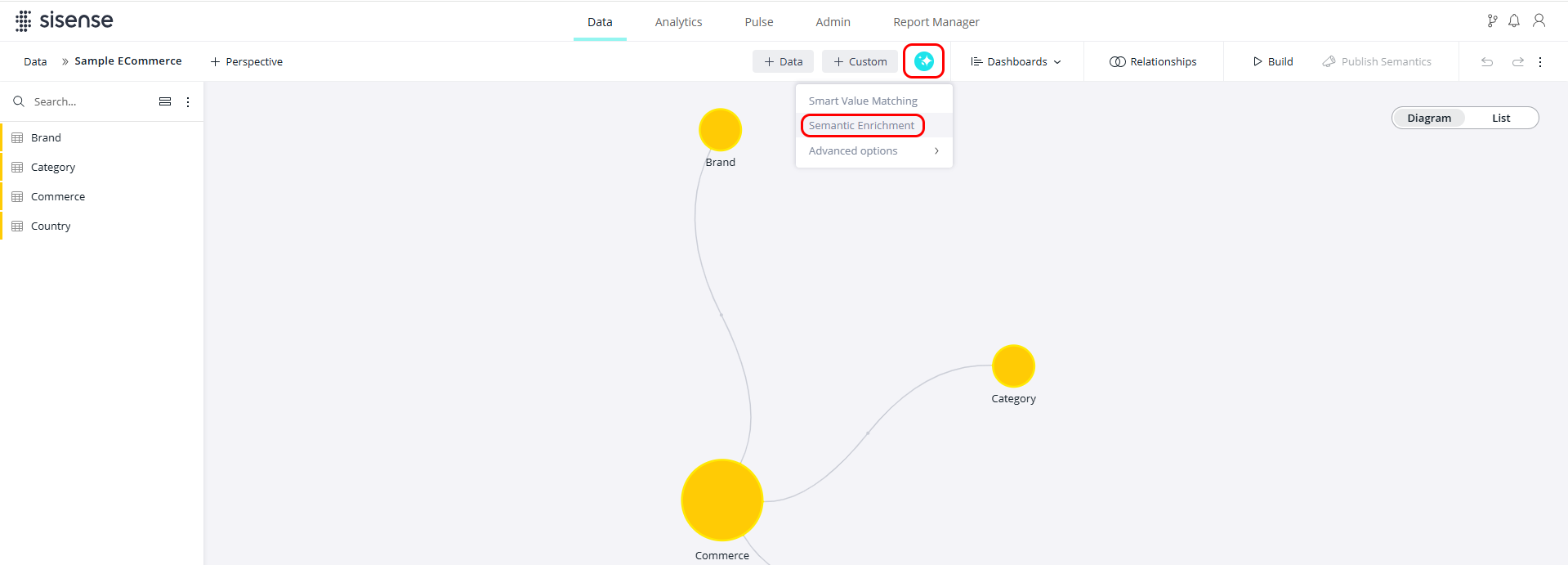
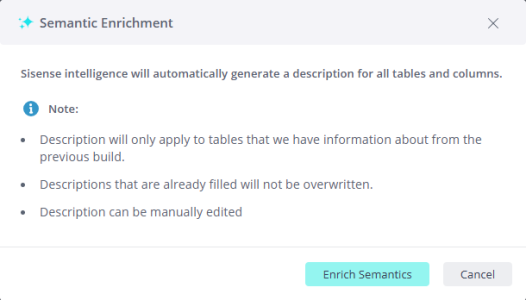
- If the Semantic Enrichment confirmation and note window is displayed, click Enrich Semantics.
-
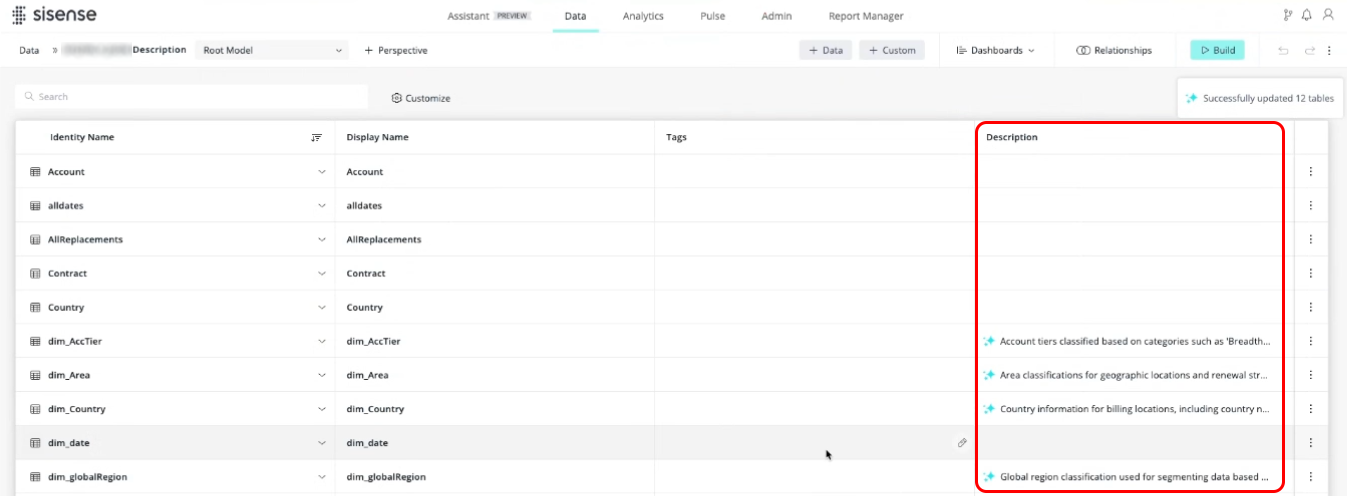
To see all generated descriptions in one place, switch to List View (using the Diagram/List toggle in the top-right corner of the model view, which may be temporarily obscured by the "Successfully updated..." message).

-
Click Customize to customize the view to display the Description column.
The Description fields (not including hidden tables/columns) are updated with the Semantic Enrichment automatically generated descriptions. Those descriptions are marked with the Sisense Intelligence icon
 .
.
Downloading the Semantic Enrichment Report
After each Semantic Enrichment run, you can download a report that lists the tables and columns that were not enriched and explains why. Use the report to understand a partial result, fix the model (for example, by calculating statistics) and run Semantic Enrichment again, write the missing descriptions manually, or share the report with Sisense Support.
To download the report:
-
In the Data tab, open the relevant data model or perspective, and click
to open the Data Assistant menu. -
Under Advanced options, click Download Semantic Enrichment Report.
A JSON file named after the data model or perspective is downloaded.
The report includes:
-
Run details – The run ID, the data model or perspective, the start and end times, the run status (completed, completed with errors, or nothing to enrich), and the token usage.
-
Summary – The number of tables and columns that were and were not enriched.
-
Tables and columns that were not enriched – Each with its status (for example, partially enriched, skipped, or failed) and the reason (for example, statistics not calculated, column already described, unsupported column type, LLM error, or quota exceeded). Successfully enriched tables and columns are not listed.
Note:
The Download Semantic Enrichment Report option is disabled until Semantic Enrichment has run on the open data model or perspective. Only the report from the latest run is kept for each data model or perspective.
Limitations and Known Issues
-
This feature requires you to set up your own Large Language Models.
-
This feature is currently off by default and can be enabled by an administrator in the Sisense Intelligence settings.
-
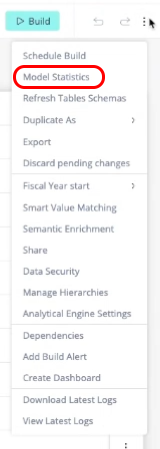
Model statistics must be enabled for the relevant model.

-
An initial build/publish must be performed before Semantic Enrichment can generate the descriptions.
-
Descriptions are not generated for hidden and dropped tables and columns.
-
Descriptions are not generated for columns with null values.
-
Manually added/edited descriptions are not overridden by the Semantic Enrichment generated descriptions.
-
The generated descriptions can be manually edited.
-
After the descriptions are generated, another build/publish must be performed for the descriptions to become available to the Sisense Intelligence assistant.
-
For Live models, the generated descriptions only become available to the Sisense Intelligence assistant a few minutes after the publish is performed.
-
-
Undo/Redo functionality has no effect on the generated descriptions.